" width="43.9999991302804px"><path d="M 7.333 0.002 C 7.633 -0.008 7.787 0.018 8.036 0.193 C 8.002 0.618 7.851 0.976 7.688 1.367 L 7.513 1.799 L 7.422 2.02 C 6.754 3.652 6.114 5.295 5.544 6.964 L 6.63 6.836 L 6.646 6.465 C 6.705 5.731 6.946 5.118 7.512 4.629 C 8.115 4.207 8.868 4.146 9.573 4.265 C 10.135 4.392 10.559 4.647 10.91 5.112 C 11.345 5.941 11.444 6.953 11.221 7.866 C 10.994 8.534 10.641 8.987 10.016 9.327 C 9.328 9.591 8.677 9.59 7.983 9.355 C 7.417 9.099 7.081 8.671 6.83 8.114 C 6.697 7.768 6.629 7.399 6.63 7.028 L 6.466 7.089 C 6.241 7.157 6.042 7.181 5.808 7.196 L 5.585 7.21 L 5.417 7.219 L 5.398 7.331 C 5.363 7.528 5.326 7.725 5.289 7.922 L 5.262 8.073 C 5.232 8.237 5.201 8.401 5.17 8.565 L 5.14 8.728 L 5.11 8.882 L 5.084 9.021 C 5.034 9.136 5.034 9.136 4.913 9.215 C 4.778 9.263 4.778 9.263 4.587 9.263 L 4.602 9.013 C 4.602 8.665 4.493 8.41 4.343 8.102 L 4.274 7.953 C 4.175 7.741 4.071 7.531 3.963 7.324 C 3.884 7.156 3.884 7.156 3.884 6.964 L 3.712 6.952 C 3.154 6.87 2.63 6.599 2.132 6.346 L 2.008 6.283 L 1.712 6.134 L 1.626 6.302 C 1.471 6.603 1.316 6.904 1.161 7.205 C 1.026 7.466 0.891 7.727 0.756 7.988 C 0.691 8.112 0.628 8.237 0.564 8.362 L 0.445 8.59 L 0.341 8.793 C 0.243 8.944 0.243 8.944 0.051 9.008 C -0.023 8.789 -0.016 8.699 0.071 8.481 C 0.113 8.4 0.156 8.321 0.199 8.242 L 0.341 7.97 L 0.418 7.823 C 0.564 7.539 0.701 7.252 0.838 6.964 L 0.919 6.795 C 1.072 6.476 1.209 6.148 1.329 5.814 C 1.298 5.788 1.268 5.761 1.236 5.734 C 0.852 5.393 0.562 4.946 0.468 4.435 C 0.458 4.147 0.49 3.925 0.69 3.706 C 0.996 3.497 1.275 3.393 1.648 3.451 C 1.869 3.544 2.078 3.653 2.287 3.77 L 2.312 3.632 C 2.351 3.451 2.404 3.282 2.464 3.107 L 2.532 2.909 L 2.672 2.504 C 2.899 1.836 3.075 1.216 2.926 0.513 C 2.576 0.578 2.238 0.645 1.904 0.768 L 1.904 0.576 C 2.021 0.478 2.021 0.478 2.175 0.381 L 2.328 0.283 C 2.636 0.1 2.879 0.005 3.245 0.066 C 3.425 0.18 3.533 0.258 3.628 0.449 C 3.733 1.377 3.473 2.287 3.071 3.12 L 2.985 3.306 C 2.928 3.424 2.868 3.54 2.805 3.654 C 2.719 3.834 2.673 3.955 2.67 4.154 C 2.784 4.365 2.923 4.533 3.079 4.716 C 3.359 5.046 3.535 5.437 3.728 5.822 L 3.85 6.058 C 4.139 6.625 4.139 6.625 4.139 6.773 L 5.097 6.9 L 5.229 6.504 C 5.523 5.615 5.822 4.727 6.127 3.842 C 6.791 1.941 6.791 1.941 7.333 0.002 Z M 0.754 4.089 C 0.745 4.562 0.931 4.769 1.251 5.105 C 1.394 5.247 1.394 5.247 1.584 5.367 C 1.686 5.159 1.788 4.951 1.89 4.743 C 1.979 4.55 1.979 4.55 1.958 4.391 C 1.861 4.193 1.711 4.126 1.52 4.025 C 1.245 3.952 0.998 3.916 0.754 4.089 Z M 2.351 4.728 L 1.904 5.686 C 2.684 6.246 2.684 6.246 3.565 6.516 C 3.459 6.217 3.302 5.962 3.133 5.694 L 3.053 5.562 C 2.865 5.263 2.663 4.98 2.415 4.728 L 2.351 4.728 Z M 7.752 5.315 C 7.42 5.771 7.367 6.253 7.377 6.804 L 7.376 6.975 C 7.381 7.596 7.457 8.107 7.908 8.561 C 8.353 8.887 8.778 8.917 9.313 8.88 C 9.709 8.796 10.052 8.598 10.283 8.257 C 10.687 7.522 10.678 6.644 10.457 5.854 C 10.322 5.463 10.095 5.22 9.76 4.983 C 9.099 4.711 8.26 4.777 7.752 5.315 Z M 4.267 7.091 L 4.451 7.586 L 4.503 7.728 L 4.554 7.865 L 4.6 7.99 C 4.653 8.12 4.716 8.244 4.778 8.369 L 5.097 7.155 Z M 29.242 0.066 C 29.414 0.205 29.526 0.316 29.625 0.513 C 29.731 1.603 29.36 2.596 28.96 3.593 L 28.895 3.756 L 28.836 3.9 C 28.785 4.034 28.785 4.034 28.794 4.217 L 28.867 4.117 C 29.318 3.499 29.769 2.885 30.263 2.301 L 30.428 2.101 C 30.81 1.641 31.215 1.21 31.637 0.788 L 31.788 0.637 C 32.226 0.204 32.226 0.204 32.435 0.066 C 32.579 0.085 32.579 0.085 32.691 0.13 C 32.787 0.427 32.705 0.622 32.587 0.896 C 32.17 1.941 31.999 3.043 31.86 4.154 L 31.994 3.994 C 32.985 2.815 33.987 1.741 35.278 0.888 L 35.387 0.815 C 35.615 0.669 35.807 0.603 36.076 0.576 C 36.151 0.713 36.151 0.713 36.204 0.896 C 36.136 1.069 36.136 1.069 36.02 1.267 C 34.862 3.406 34.098 6.803 34.799 9.199 C 35.016 9.768 35.239 10.084 35.753 10.401 C 36.396 10.647 37.073 10.479 37.684 10.24 C 37.872 10.16 37.872 10.16 38.056 10.03 L 38.312 10.03 L 38.312 10.285 C 38.136 10.37 37.96 10.453 37.785 10.537 L 37.634 10.609 L 37.488 10.678 L 37.355 10.742 C 36.798 10.976 35.99 10.954 35.414 10.805 C 35.263 10.734 35.121 10.646 34.99 10.541 L 34.865 10.442 C 34.295 9.935 34.035 9.112 33.968 8.369 C 33.852 5.936 34.305 3.364 35.501 1.215 C 34.62 1.955 33.757 2.699 33.01 3.579 L 32.846 3.768 C 32.725 3.91 32.604 4.054 32.485 4.198 C 32.376 4.331 32.267 4.449 32.144 4.57 C 31.618 5.134 31.609 5.816 31.531 6.556 C 31.489 6.935 31.412 7.218 31.202 7.539 C 31.094 7.603 31.094 7.603 30.902 7.611 C 30.711 7.539 30.711 7.539 30.587 7.347 C 30.395 6.779 30.667 6.202 30.902 5.686 L 30.997 5.532 C 31.274 5.072 31.343 4.709 31.358 4.178 C 31.388 3.573 31.442 2.982 31.541 2.385 L 31.573 2.187 C 31.632 1.839 31.706 1.493 31.797 1.151 C 31.295 1.64 30.825 2.133 30.391 2.684 L 30.208 2.91 C 29.807 3.4 29.425 3.906 29.063 4.426 C 28.988 4.534 28.912 4.64 28.836 4.745 C 28.472 5.26 28.172 5.806 27.88 6.365 C 27.843 6.436 27.806 6.508 27.767 6.582 C 27.408 7.282 27.111 7.969 27.006 8.752 C 26.583 8.705 26.583 8.705 26.367 8.561 C 26.407 8.317 26.479 8.116 26.583 7.893 L 26.68 7.681 L 26.787 7.451 C 28.513 4.16 28.513 4.16 28.922 0.64 C 28.849 0.554 28.849 0.554 28.655 0.561 C 28.396 0.578 28.252 0.643 28.028 0.768 L 27.9 0.768 C 27.923 0.589 27.949 0.525 28.09 0.406 L 28.244 0.309 L 28.397 0.211 C 28.651 0.06 28.952 0.009 29.242 0.066 Z M 28.602 4.345 L 28.666 4.473 M 31.221 5.878 C 30.989 6.29 30.861 6.619 30.838 7.092 L 31.094 7.092 C 31.23 6.692 31.259 6.299 31.285 5.878 Z M 18.52 4.569 C 18.941 4.907 19.209 5.326 19.321 5.853 L 19.37 6.072 C 19.414 6.387 19.405 6.709 19.405 7.027 L 15.892 7.027 C 16.036 7.892 16.036 7.892 16.495 8.584 C 16.901 8.842 17.273 8.864 17.745 8.816 C 18.156 8.701 18.385 8.442 18.639 8.113 L 18.766 7.985 L 19.278 8.241 C 19.169 8.674 18.84 9.003 18.47 9.246 C 17.878 9.549 17.256 9.606 16.609 9.443 C 16.102 9.257 15.668 8.886 15.431 8.401 C 15.066 7.523 15.028 6.363 15.365 5.468 C 15.611 4.96 15.975 4.55 16.51 4.342 C 17.208 4.135 17.904 4.152 18.52 4.569 Z M 16.212 5.367 C 15.967 5.743 15.945 5.973 15.892 6.452 L 18.639 6.452 C 18.58 5.863 18.526 5.553 18.168 5.119 C 17.561 4.628 16.692 4.782 16.211 5.367 Z" fill="rgb(0, 0, 0)" height="10.917437449222685px" id="AGutxb3Yn" transform="translate(0 0)" width="38.31175535682081px"/><path d="M 27.593 2.235 C 27.757 2.233 27.922 2.231 28.086 2.229 C 28.232 2.235 28.232 2.235 28.296 2.299 C 28.302 2.406 28.305 2.513 28.305 2.619 L 28.306 2.826 L 28.307 3.051 L 28.312 3.522 C 28.314 3.771 28.316 4.018 28.317 4.267 C 28.318 4.506 28.32 4.744 28.323 4.983 L 28.323 5.206 C 28.329 5.655 28.376 6.061 28.615 6.451 C 28.901 6.701 29.165 6.729 29.533 6.724 C 29.854 6.691 30.101 6.584 30.31 6.334 C 30.637 5.836 30.679 5.377 30.686 4.793 L 30.689 4.571 C 30.693 4.338 30.696 4.105 30.699 3.872 L 30.706 3.397 C 30.713 3.01 30.718 2.623 30.723 2.235 L 31.426 2.235 L 31.489 7.281 L 30.851 7.281 L 30.723 6.643 L 30.564 6.85 C 30.249 7.217 29.859 7.381 29.382 7.419 C 28.878 7.44 28.475 7.331 28.08 7.01 C 27.733 6.682 27.606 6.297 27.585 5.822 L 27.586 5.622 L 27.586 5.393 L 27.587 5.148 L 27.587 4.896 L 27.589 4.235 L 27.59 3.559 C 27.591 3.118 27.592 2.676 27.593 2.235 Z M 4.407 1.214 L 4.982 1.214 L 4.982 2.299 L 6.196 2.299 L 6.196 2.938 L 4.982 2.938 C 4.988 3.423 4.995 3.909 5.002 4.394 L 5.009 4.89 C 5.012 5.127 5.016 5.364 5.02 5.602 L 5.022 5.825 L 5.025 6.034 L 5.028 6.218 C 5.047 6.403 5.091 6.541 5.174 6.707 C 5.369 6.804 5.574 6.777 5.788 6.774 L 5.925 6.774 C 6.037 6.773 6.148 6.772 6.26 6.77 L 6.26 7.345 C 5.114 7.539 5.114 7.539 4.611 7.237 C 4.212 6.816 4.254 6.338 4.261 5.789 L 4.261 5.541 C 4.262 5.326 4.264 5.11 4.266 4.895 C 4.269 4.242 4.273 3.59 4.28 2.938 L 3.577 2.938 L 3.577 2.299 L 4.28 2.299 Z M 12.2 0.064 L 12.902 0.064 L 12.902 7.345 L 12.2 7.345 Z M 33.023 0 L 33.725 0 L 33.725 7.281 L 33.023 7.281 Z M 35.003 2.235 L 35.642 2.235 L 35.642 7.281 L 35.003 7.281 Z M 1.342 0.224 L 1.549 0.235 L 1.757 0.244 L 1.916 0.255 C 1.885 0.538 1.797 0.66 1.593 0.854 L 1.436 1.004 C 1.252 1.173 1.066 1.339 0.875 1.5 C 0.757 1.6 0.757 1.6 0.639 1.752 C 0.435 1.911 0.252 1.869 0 1.852 C 0.038 1.643 0.107 1.522 0.243 1.359 L 0.352 1.227 L 0.467 1.09 L 0.69 0.821 L 0.798 0.693 C 0.904 0.566 0.904 0.566 1.024 0.384 C 1.15 0.255 1.15 0.255 1.342 0.224 Z M 30.448 0.179 L 30.64 0.184 L 30.787 0.191 C 30.739 0.631 30.411 0.869 30.112 1.169 L 29.941 1.349 C 29.527 1.768 29.527 1.768 29.29 1.826 C 29.149 1.826 29.149 1.826 28.934 1.788 C 28.974 1.568 29.056 1.437 29.193 1.262 L 29.313 1.11 L 29.438 0.953 L 29.561 0.796 C 30.057 0.165 30.057 0.165 30.448 0.179 Z M 35.003 0.128 L 35.642 0.128 L 35.642 1.022 L 35.003 1.022 Z" fill="rgb(0, 0, 0)" height="7.479521951991309px" id="sg9LEzmJ7" transform="translate(8.358 2.134)" width="35.641538703949834px"/></g></svg>)
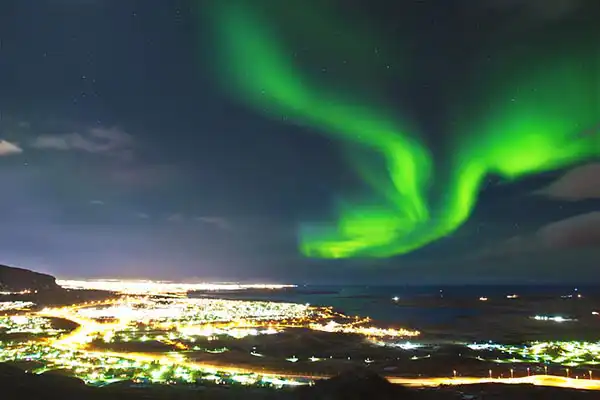
It usually starts as something you are not sure you saw. A pale grey smudge above the rooftops, the kind of thing you would take for cloud if it were not so still. Then it shifts.
In Reykjavík that happens more often than most visitors expect, and closer to the middle of the city than they expect too. This is one of the few capitals where you can walk ten minutes from your room and stand under a working aurora sky, no minibus required.
This guide covers everything you need for that: what the lights actually are, how much darkness and how much cloud each month of the season really gives you, where to stand inside the city and just outside it, how to read the Icelandic forecast in ninety seconds, what tours cost, what to wear, and how many nights to give yourself.
What the northern lights actually are
How an aurora forms, in plain terms
The sun constantly throws off a stream of charged particles known as the solar wind. Most of it slides past Earth. Some of it gets caught by our magnetic field and funnelled towards the poles, where those particles hit gas atoms high in the atmosphere and knock them into an excited state. As the atoms settle back down, they release the energy as light. That light is the aurora.
Bursts on the sun's surface, solar flares and coronal mass ejections, send a denser, faster load of particles our way. Those take roughly one to three days to arrive, which is why the aurora can be forecast a couple of days out and no further. The Icelandic Meteorological Office explains that satellite readings give around one more hour of warning once the particles are close.
Why it is usually green, and occasionally red or purple
Colour depends on which gas is hit, and how high up.
Colour | Gas and altitude | How often you see it |
Green | Oxygen, roughly 100–150 km up | The standard aurora, by a wide margin |
Red | Oxygen, above roughly 200 km | Occasional, usually on active nights |
Blue and violet | Nitrogen, lower down | Rare, seen at the bottom edge of strong displays |
Pink fringe | Nitrogen at the lower border | Fairly common on bright, fast-moving curtains |
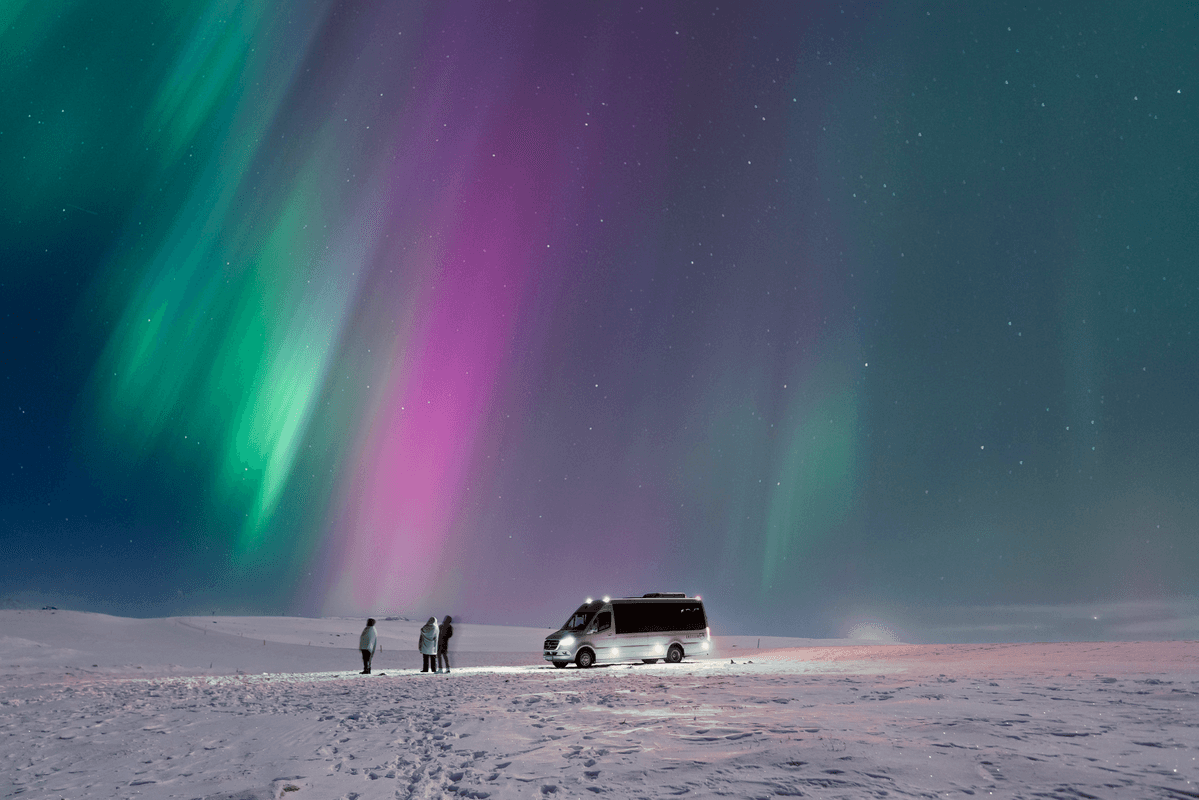
One expectation to set now: to the naked eye, a weak aurora often looks grey or silvery rather than green. That is your eyes, not the sky. Human night vision relies on cells that barely register colour, while a camera sensor does not have that limitation. A phone photograph will often be greener and more dramatic than what you are looking at. On a strong night, the colour arrives for the eye too, and it is unmistakable.
Why Reykjavík sits in a good spot
The aurora concentrates in a ring around the magnetic pole, the auroral oval. Iceland sits under it. Note a common mistake: Reykjavík is at roughly 64°N, which is below the Arctic Circle, not above it. The Circle only clips Iceland at the island of Grímsey off the north coast. The city does not need to be inside it, because the oval reaches further south than the Circle does.
What Reykjavík does have to contend with is its own light. It is a small capital by international standards, and the darkness needed for aurora viewing sits a short walk away rather than a long drive.
When to see the northern lights in Reykjavík
The aurora season: late August to mid-April
The aurora is above Iceland all year. You just cannot see it in June, because the sky never goes properly dark. Darkness is the limit, not the sun. That is why the season in Reykjavík runs from late August to mid-April, with its darkest, steadiest stretch between November and February.
Below is the season in numbers, which is not something most guides bother to give you. Sunset and sunrise are for mid-month at Reykjavík's latitude. The third column is the one that matters: hours per night when the sun is more than 12° below the horizon, which is roughly the point at which the sky is dark enough for a moderate aurora to show. The last column is the 1991–2020 average cloud cover for that month, from the Icelandic Meteorological Office's own records, in oktas — eighths of the sky.
Mid-month | Sunset | Sunrise | Dark enough (sun below −12°) | Mean cloud cover |
Late August | 21:10 | 05:50 | 3.9 h | 6.0 oktas (74%) |
September | 19:55 | 06:50 | 7.3 h | 6.0 oktas (75%) |
October | 18:10 | 08:20 | 10.7 h | 5.7 oktas (71%) |
November | 16:30 | 09:55 | 13.4 h | 5.7 oktas (71%) |
December | 15:30 | 11:15 | 14.9 h | 5.8 oktas (72%) |
January | 16:20 | 10:55 | 14.2 h | 6.0 oktas (74%) |
February | 18:00 | 09:25 | 11.8 h | 5.9 oktas (74%) |
March | 19:30 | 07:50 | 8.8 h | 5.9 oktas (74%) |
April | 21:00 | 06:00 | 4.4 h | 5.7 oktas (72%) |
Cloud is the real constraint, and it barely changes
Look down that last column again. Across the whole aurora season, Reykjavík's average cloud cover moves between 5.7 and 6.0 oktas. In plain terms: in every month of the year, the average sky over the city is around three-quarters covered. There is no clear month to book.
October and November are marginally the clearest of the season and September the cloudiest, but the gap is a third of an okta — far too small to plan a trip around. This is the single most useful thing to understand about aurora hunting in Iceland, and it leads to three conclusions:
Choose your month for darkness, not for weather. Darkness varies by a factor of four across the season. Cloud does not vary at all, to speak of.
Expect most nights to be partly cloudy. A completely clear sky is the exception in every month. Partly cloudy is workable — gaps move, and the aurora is patient.
Plan several nights, and be willing to drive. Since you cannot book a clear month, the only real lever you have is the number of attempts and your ability to move towards a gap.
The equinox weeks, and what the moon does
Two smaller details shift the odds. The weeks around the equinoxes, which fall on 20 March and 22–23 September in 2026, tend to be more active, because the tilt of Earth's magnetic field couples more efficiently with the solar wind at those times of year. September buys you activity but only around seven hours of darkness and the season's thickest cloud; December buys you fifteen hours of darkness away from the equinox peak. Neither is wrong.
The moon matters less than people fear. A full moon washes out a faint display and leaves a strong one perfectly visible, and it lights the landscape underneath, which many photographers prefer. The Icelandic Meteorological Office publishes moonrise alongside its aurora forecast so you can plan around it. If you are still choosing dates, our guide to when to visit Iceland, season by season sets the wider picture.
The best hours of the night, and why 22:00–02:00 is only a guideline
Most guides give you 22:00 to 02:00. It is a fair average, and it is not a rule. The real condition is the one in the table: full darkness, clear sky. In December that starts around 17:00, and a good display at 18:30 counts just as much as one at midnight.
So rather than standing outside for four hours, step out twice. Once around 21:00, once near midnight. Twenty patient minutes each time, with your back to the streetlights, will tell you more than a long, cold vigil. Displays also come in waves: a sky that looks empty at 22:15 can be busy twenty minutes later, so leaving after five minutes is the most common mistake there is.
What the 2026–2027 solar cycle means for your winter
Solar Cycle 25 reached its maximum in October 2024 and has been in its declining phase since, with fewer sunspots than in the peak years. That sounds like bad news. It is not, particularly. Writing for the UK Met Office in January 2026, Space Weather Manager Krista Hammond pointed out that this phase has form:
the strongest and most significant space weather events after solar maximum
Her point was borne out within days of publication, when aurora was reported as far south as northern Italy. Set against that, Reykjavík has a quiet structural advantage: sitting beneath the auroral oval, it does not need a storm for something to appear. This winter is above average rather than record-breaking. Good odds, no guarantees.
Where to see the northern lights in and around Reykjavík
Free viewing spots you can walk to, away from light pollution
You do not need to leave town on night one. You need open sky, a dark patch of ground, and no streetlamp in your eyeline. Laugardalur valley, Klambratún and Öskjuhlíð below the Perlan dome all qualify, and all sit within a short walk of the quiet streets around Hallarmúli.
None of them costs anything, which is the practical point. You can step out at 23:00, look for twenty minutes and be back inside. Doing that on three separate nights is easy. Driving out on three separate nights is not.
Spot | Getting there | Light pollution | Best for |
Laugardalur valley | Short walk from the Laugardalur hotels | Low for a city park | A quick look before bed |
Klambratún | Around ten minutes on foot | Moderate | Open sky close to the centre |
Öskjuhlíð | Short walk or a few minutes by car | Moderate, screened by trees | Elevation and shelter |
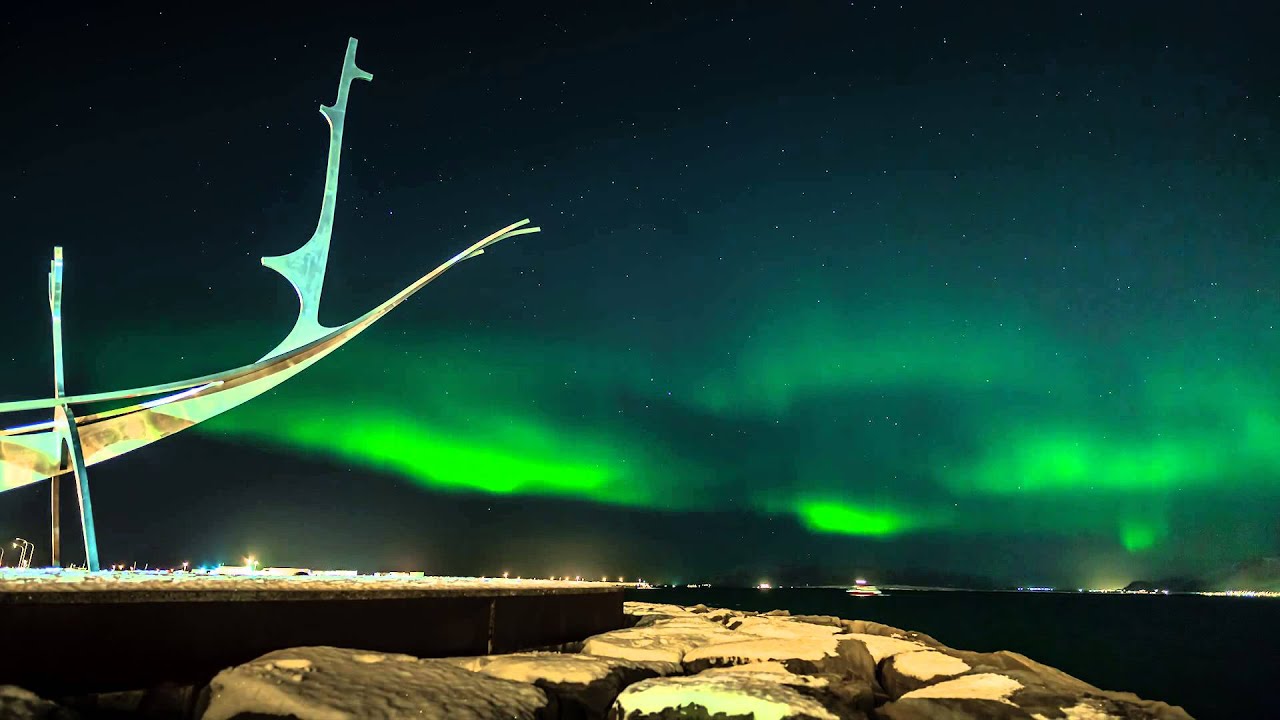
Old harbour and Sun Voyager | Walk from the centre | Moderate, open to the north | Reflections on water |
Grótta lighthouse | About twenty minutes by car | Low | Open ocean horizon |
Heiðmörk / Elliðaárdalur | Twenty to thirty minutes by car | Very low | Escaping cloud and city glow |
Grótta lighthouse and the city's dark edges
Grótta, at the tip of the Seltjarnarnes peninsula, is the strongest option still inside the city area: an open ocean horizon to the north and very little direct glare. Two cautions before you go. The causeway floods at high tide, so check tide times rather than your watch, and parts of the reserve close during the spring nesting season.
Wherever you end up, one habit does more than any location: give your eyes fifteen to twenty minutes to adjust before deciding the sky is empty. A faint band often resolves into something once you stop looking at your phone. If you need light to move around, a head torch with a red setting protects that adjustment; a white beam undoes it in a second, for you and for everyone standing near you.
When it is worth driving twenty minutes out
Twenty to thirty minutes reaches properly dark ground: Heiðmörk nature reserve, Elliðaárdalur valley, Vífilsstaðavatn lake. Given the cloud figures above, the reason to drive is usually not darkness at all. The aurora is out, and Reykjavík simply happens to be sitting under the one grey patch on the map.
Which makes the return leg worth thinking about. Free private parking means a midnight drive ends with you pulling in and going to bed, rather than circling for a space at two in the morning — one reason Reykjavík's quiet green valley works as a base for aurora nights.
Further afield, if you have a car and a spare evening
Within reach of the city on a longer night: Þingvellir national park, about 45 minutes east, where the rift valley gives you dark ground and a wide horizon. Kleifarvatn and the Reykjanes peninsula lie south-west, roughly the same distance, with almost no settlement in between. Both mean driving Icelandic roads in winter darkness, so check road conditions before committing, and turn back without hesitation if the weather closes in. A guided tour exists precisely to remove that decision from your evening.
How to read the aurora forecast before you go outside
The Kp index: what the number tells you, and what it doesn't
The Kp index runs from 0 to 9 and measures how disturbed Earth's magnetic field is worldwide. It is not a brightness reading for the sky above your head. That distinction matters here: sitting under the auroral oval, Reykjavík does not need a storm to see something.
Forecast value | What it means | In Reykjavík | Worth leaving the city? |
0–1 | Quiet | Little or nothing, even in the dark spots | No |
2–3 | Low to moderate | Often visible away from streetlights | Only to escape cloud |
4–5 | Active | Can show through city glare | Worth a short drive |
6+ | Storm | Rare, and hard to miss | Anywhere with clear sky |
Treat it as a background probability rather than a forecast of your evening. It is dependable one to three days ahead; beyond that it is a guess. Solar wind speed is the useful companion number — below 300 km/s tends to be weak, 300 to 500 km/s fair, above 500 km/s promising.
Cloud cover on vedur.is: white is clear, green is cloudy
Here is the detail worth getting right, because a great many English-language guides state it backwards. On the Icelandic Meteorological Office's own aurora page, the map key reads:
Green areas are cloudy and white areas clear skies.
Green is not your friend. White is. We checked the page again in August 2026 and the key is unchanged, but it takes three seconds to confirm for yourself before you trust anyone's summary, including ours.
The routine that follows takes about ninety seconds:
Open the aurora forecast at en.vedur.is.
Read the cloud map first. Find the white patches.
Read the activity value in the top-right box, set for midnight.
Check the darkness and moonrise times, which the page gives for Reykjavík.
Decide: walk to one of the spots above, or drive towards the nearest white.
Cloud first, always. A quiet sky under clear air beats a strong reading under an overcast one, every time.
Apps and other tools worth having
The Met Office page is the one that matters in Iceland, because it is the only one combining local cloud with activity. Alongside it:
NOAA's 30-minute forecast — a live map of the auroral oval, useful for seeing whether the band is drifting your way tonight.
An alert app such as My Aurora Forecast or SpaceWeatherLive — set a threshold and let your phone tell you, rather than checking every twenty minutes.
A tide table, if Grótta is on your list.
The road conditions map at road.is, before any winter drive outside the city.
Northern lights tours from Reykjavík: types and prices
What each type costs, and what it buys
A guided tour buys two things you cannot easily buy alone: range, and a driver who has been watching the cloud maps since lunchtime. Given how little the cloud figures vary, that mobility is the product. Without a car it is close to essential — though getting around Reykjavík without a rental is otherwise straightforward.
Prices below are per person unless stated, checked in August 2026, and will move with season and demand.
Type | Typical price | Length | Suits | Trade-off |
Coach tour | ~10,000–15,000 ISK | 3–4 h | First-timers, lowest cost | Large groups, fixed stops, main roads only |
Boat from the old harbour | ~14,000–14,500 ISK | 2 h | A clean unlit horizon, short evening | Cold on deck, cancelled in swell |
Minibus, small group | ~19,000–21,000 ISK | 4–5 h | Flexibility, a guide you can talk to | Costs more per head than a coach |
Super jeep, shared | ~25,000–35,000 ISK | 4–5 h | Reaching ground coaches cannot | The priciest shared option |
Private vehicle | From ~139,000–160,000 ISK per group | 3–4 h | Families, photographers, full control | Only sensible split across four or five people |
Booking one well
Two things worth knowing before you book. Most operators offer a free second attempt if nothing appears, and several extend it for up to three years, so booking early in your stay leaves that option open. Later in the week it is wasted. And tours cancel routinely when the forecast is poor, with the call usually made in the early evening, which is a good sign rather than a bad one. Keep the night flexible. Trips can be arranged at reception through TourDesk, or browsed in advance among our tours and activities.
Photographing the northern lights
Camera and phone settings
Aurora photography is mostly a matter of holding still and letting light in. Set the camera manually and stop fiddling.
Setting | Camera | Phone |
Aperture | Widest available, f/2.8 or lower | Fixed |
ISO | ISO 1600–3200 | Handled by night mode |
Shutter | 2s–10s, shorter when the display moves fast | 3s–10s night mode |
Focus | Manual, set to infinity on a bright star | Tap a distant light, then lock |
Support | Tripod, no exceptions | Small tripod, or braced on a wall |
A note on shutter speed that most guides skip: longer is not better. A fast, structured curtain photographed at twenty seconds turns into a green smear. When the display is moving, come down to two or four seconds and raise the ISO instead.
Composition, and keeping the kit alive
Photographs of bare sky rarely hold up. Put something in the bottom third: a lighthouse, a church spire, the shoreline, a person standing still. Water helps twice over, once for the reflection and once for the shape it gives the frame.
Batteries drain quickly below freezing. Keep a spare in an inside pocket, warm against you.
Shoot in RAW if you can, since aurora colour is much easier to correct afterwards.
Bring the camera into a bag before entering a warm room, so condensation forms on the bag rather than the lens.
Turn your screen brightness right down. It preserves your night vision and everyone else's.
What to wear, and what to bring
Dressing for a night that ends at one in the morning
Clear nights are the cold ones. Reykjavík winters are milder than most people assume, but the Icelandic Meteorological Office recorded a low of −10.8 °C in the city in February 2024, and coastal wind out at the peninsula makes it feel colder still. Standing still for forty minutes is a different proposition from walking.
Thermal base layer, top and bottom
Insulating mid-layer — wool or fleece
Windproof, waterproof outer shell
Hat, and thin liner gloves under warm gloves, so you can still work a shutter
Warm, waterproof boots and proper socks
The small things that make the wait bearable
A thermos, a head torch with a red mode, hand warmers, and a folded mat or blanket if you plan to sit. A warm drink before you leave helps more than an extra layer. Free hot drinks in the lounges make that easy at either end of the night.
What else to do on an aurora night
The forecast will not cooperate every evening — the cloud figures above guarantee that — and the hours before midnight need filling. Reykjavík is well set up for it. The geothermal pools stay open late and cost very little; Laugardalslaug, the largest of them, is a short walk from the Laugardalur neighbourhood and its hot pots are a reasonable place to be while you wait for the sky to clear. Perlan's planetarium runs an aurora show for nights when the real one stays hidden. The Sky Lagoon and the Blue Lagoon both offer evening slots, with the aurora as an occasional bonus rather than the point.
Treating the lights as something the evening might add, rather than the reason for the trip, is the single best adjustment most visitors can make.
Northern lights in Icelandic and Norse folklore
Norse tradition read the lights as reflections from the armour of the Valkyries riding above the battlefield, a sign that carried both protection and warning. Icelandic folklore is more domestic and stranger. Nineteenth-century collections of Icelandic folk tales record the belief that the aurora eased the pain of childbirth, paired with a warning that an expectant mother should not look directly at them, or the child would be born cross-eyed. Elsewhere the lights were read as a change in the weather, which, given that a clear aurora sky usually means cold air moving in, was not entirely superstition.
The name is younger than the folklore. Aurora borealis combines the Roman goddess of dawn with the Greek name for the north wind, and came into common use in the seventeenth century. In modern Iceland the lights turn up everywhere from album covers to tourism campaigns, which is its own kind of continuity.
Five mistakes that cost people the aurora
Booking one night. With three-quarters average cloud cover, one night is a coin toss at best. Three or four, checking the forecast each evening, turn the odds decisively.
Reading the Kp value and ignoring cloud. Cloud beats everything. Check it first.
Giving up after five minutes. Displays pulse. Twenty minutes is the minimum useful wait.
Standing under a streetlamp. Even a single bright light in your field of view will hide a faint band.
Dressing for the walk rather than the wait. Standing still in −5 °C with wind is a different climate from walking in it.
How many nights to plan, and what to look for in a base
Three or four nights is the sensible minimum during the season. Two leaves no room for a cloudy spell; three or four let you shrug off a grey evening and try again without the trip hanging on it.
Which changes what you should look for in a place to stay. A way back in whenever the night ends, without ceremony. Laundry, on a longer trip. Rooms quiet enough that a 02:00 return does not cost you the morning, and a breakfast that is still there when you surface. For a family or a longer stay, an apartment with a separate living room keeps late returns from waking everyone; you can see the options among our quiet, soundproofed rooms.
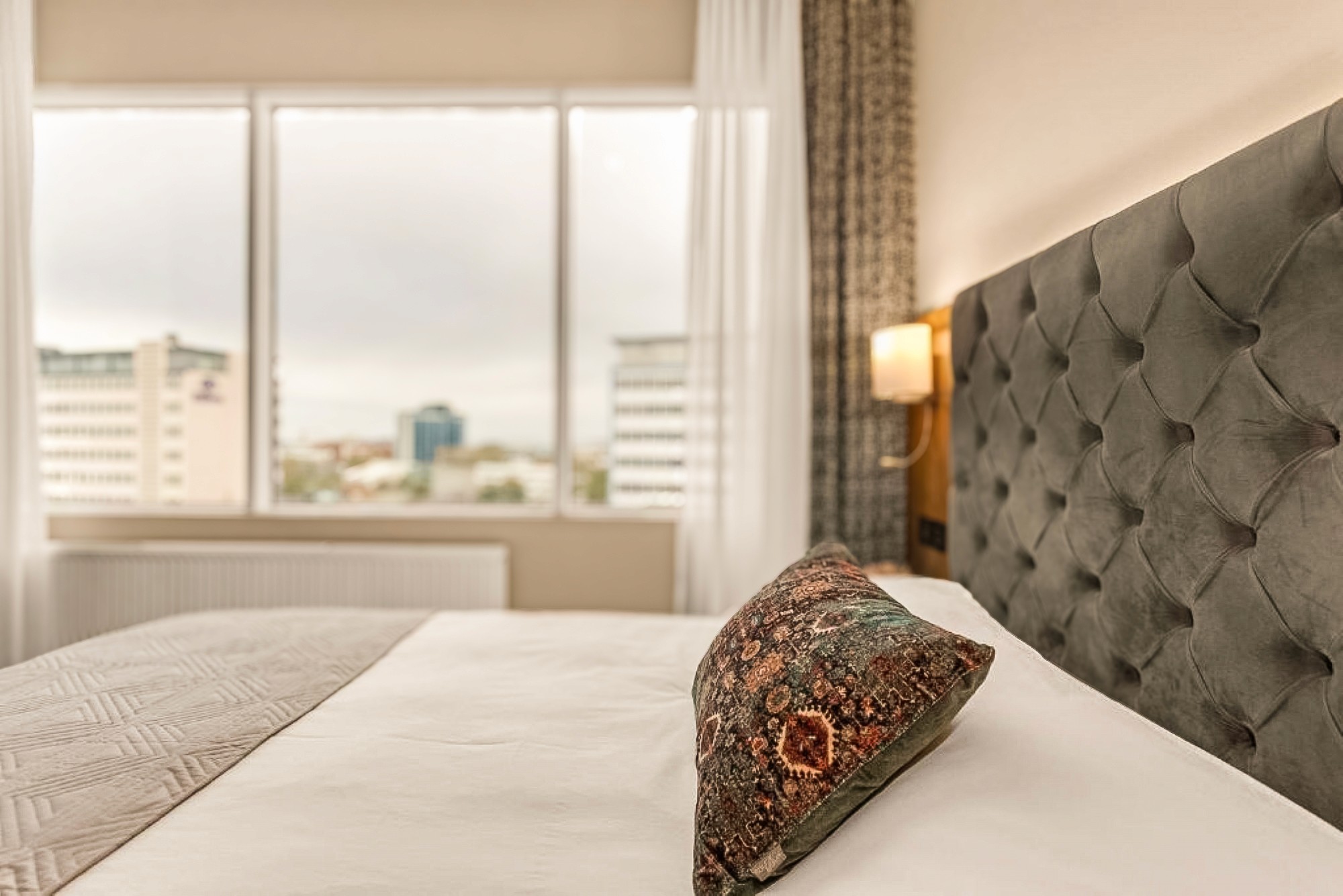
Book earlier than you think, too. Statistics Iceland recorded roughly 392,000 hotel nights across the country in February 2026, around 6% up on the year before. The aurora months are no longer the quiet season.
Frequently asked questions
Can you see the northern lights in Reykjavík city centre?
Yes, on an active night. The centre carries more glare than the parks, so a stronger display is needed before it shows above the rooftops. Walk five or ten minutes towards darker ground and the same sky becomes far easier to read. The seafront helps most, since water gives you an open northern horizon with nothing built on it.
What time do the northern lights usually appear in Reykjavík?
Most often between 22:00 and 02:00, though that is an average rather than a rule. The aurora can appear whenever the sky is fully dark and clear, which in December means from around 17:00. Displays also come in waves, so a sky that looks empty at 22:15 can be busy twenty minutes later.
Which month is best for the northern lights in Reykjavík?
For darkness, December and January, with roughly fourteen to fifteen hours a night dark enough to see a display. For cloud, it barely matters: the city's average cover sits between 5.7 and 6.0 oktas in every month of the season. October and November are marginally the clearest, and also give you ten to thirteen hours of darkness.
Where do you go to see the northern lights in Reykjavík?
Laugardalur valley, Klambratún and Öskjuhlíð are the free, walkable options; Grótta lighthouse is the darkest spot still inside the city area, about twenty minutes by car. If the whole city is under cloud, Heiðmörk or Elliðaárdalur are worth the extra twenty minutes. Anywhere with open sky and no streetlamp in front of you will do.
How much does a northern lights tour from Reykjavík cost?
Checked in August 2026: coach tours run around 10,000 to 15,000 ISK per person, boat trips from the old harbour around 14,000, small-group minibuses around 19,000 to 21,000, and shared super jeeps roughly 25,000 to 35,000. Private vehicles start near 139,000 ISK for the whole group. Most include a free retry if nothing appears.
Can I guarantee that I will see the northern lights?
No, and any page that promises otherwise is selling something. The aurora depends on solar activity and cloud, neither of which anyone controls or forecasts reliably more than a few days out. What you can control is the number of chances you give yourself, and how little each failed attempt costs you in time and cold.
Why do the northern lights look grey rather than green?
Because human night vision barely registers colour. The cells your eyes use in low light see brightness and shape far better than hue, so a faint aurora reads as pale grey or silver. Your camera has no such limit, which is why photographs look greener. On a strong display, the colour appears to the naked eye too.
Is Reykjavík inside the Arctic Circle?
No. Reykjavík sits at roughly 64°N, a little south of the Circle, which crosses Iceland only at the island of Grímsey off the north coast. It makes no practical difference for the aurora: what matters is sitting under the auroral oval, which reaches well south of the Circle and covers the whole country.
Northern lights in Reykjavík, at your own pace
What separates people who see the aurora from people who do not is rarely equipment or luck. It is temperament, and a willingness to accept the numbers above: most nights are cloudy, most displays are quiet, and neither fact says anything about tomorrow. Some nights you come back in after ten minutes, cold and mildly disappointed, and it arrives an hour later while you are reading — and you go out again in your coat and boots, laughing at yourself. That is much easier to take when the walk home is five minutes rather than an hour on a coach.
So give yourself a few evenings, dress properly, and let the season do the rest. When you're ready to slow down in Reykjavík, Múli sits a short walk from open sky, with free parking, something warm whenever you come back and a breakfast that waits for you — a quiet base for aurora nights, whenever the sky decides to cooperate.