" width="43.9999991302804px"><path d="M 7.333 0.002 C 7.633 -0.008 7.787 0.018 8.036 0.193 C 8.002 0.618 7.851 0.976 7.688 1.367 L 7.513 1.799 L 7.422 2.02 C 6.754 3.652 6.114 5.295 5.544 6.964 L 6.63 6.836 L 6.646 6.465 C 6.705 5.731 6.946 5.118 7.512 4.629 C 8.115 4.207 8.868 4.146 9.573 4.265 C 10.135 4.392 10.559 4.647 10.91 5.112 C 11.345 5.941 11.444 6.953 11.221 7.866 C 10.994 8.534 10.641 8.987 10.016 9.327 C 9.328 9.591 8.677 9.59 7.983 9.355 C 7.417 9.099 7.081 8.671 6.83 8.114 C 6.697 7.768 6.629 7.399 6.63 7.028 L 6.466 7.089 C 6.241 7.157 6.042 7.181 5.808 7.196 L 5.585 7.21 L 5.417 7.219 L 5.398 7.331 C 5.363 7.528 5.326 7.725 5.289 7.922 L 5.262 8.073 C 5.232 8.237 5.201 8.401 5.17 8.565 L 5.14 8.728 L 5.11 8.882 L 5.084 9.021 C 5.034 9.136 5.034 9.136 4.913 9.215 C 4.778 9.263 4.778 9.263 4.587 9.263 L 4.602 9.013 C 4.602 8.665 4.493 8.41 4.343 8.102 L 4.274 7.953 C 4.175 7.741 4.071 7.531 3.963 7.324 C 3.884 7.156 3.884 7.156 3.884 6.964 L 3.712 6.952 C 3.154 6.87 2.63 6.599 2.132 6.346 L 2.008 6.283 L 1.712 6.134 L 1.626 6.302 C 1.471 6.603 1.316 6.904 1.161 7.205 C 1.026 7.466 0.891 7.727 0.756 7.988 C 0.691 8.112 0.628 8.237 0.564 8.362 L 0.445 8.59 L 0.341 8.793 C 0.243 8.944 0.243 8.944 0.051 9.008 C -0.023 8.789 -0.016 8.699 0.071 8.481 C 0.113 8.4 0.156 8.321 0.199 8.242 L 0.341 7.97 L 0.418 7.823 C 0.564 7.539 0.701 7.252 0.838 6.964 L 0.919 6.795 C 1.072 6.476 1.209 6.148 1.329 5.814 C 1.298 5.788 1.268 5.761 1.236 5.734 C 0.852 5.393 0.562 4.946 0.468 4.435 C 0.458 4.147 0.49 3.925 0.69 3.706 C 0.996 3.497 1.275 3.393 1.648 3.451 C 1.869 3.544 2.078 3.653 2.287 3.77 L 2.312 3.632 C 2.351 3.451 2.404 3.282 2.464 3.107 L 2.532 2.909 L 2.672 2.504 C 2.899 1.836 3.075 1.216 2.926 0.513 C 2.576 0.578 2.238 0.645 1.904 0.768 L 1.904 0.576 C 2.021 0.478 2.021 0.478 2.175 0.381 L 2.328 0.283 C 2.636 0.1 2.879 0.005 3.245 0.066 C 3.425 0.18 3.533 0.258 3.628 0.449 C 3.733 1.377 3.473 2.287 3.071 3.12 L 2.985 3.306 C 2.928 3.424 2.868 3.54 2.805 3.654 C 2.719 3.834 2.673 3.955 2.67 4.154 C 2.784 4.365 2.923 4.533 3.079 4.716 C 3.359 5.046 3.535 5.437 3.728 5.822 L 3.85 6.058 C 4.139 6.625 4.139 6.625 4.139 6.773 L 5.097 6.9 L 5.229 6.504 C 5.523 5.615 5.822 4.727 6.127 3.842 C 6.791 1.941 6.791 1.941 7.333 0.002 Z M 0.754 4.089 C 0.745 4.562 0.931 4.769 1.251 5.105 C 1.394 5.247 1.394 5.247 1.584 5.367 C 1.686 5.159 1.788 4.951 1.89 4.743 C 1.979 4.55 1.979 4.55 1.958 4.391 C 1.861 4.193 1.711 4.126 1.52 4.025 C 1.245 3.952 0.998 3.916 0.754 4.089 Z M 2.351 4.728 L 1.904 5.686 C 2.684 6.246 2.684 6.246 3.565 6.516 C 3.459 6.217 3.302 5.962 3.133 5.694 L 3.053 5.562 C 2.865 5.263 2.663 4.98 2.415 4.728 L 2.351 4.728 Z M 7.752 5.315 C 7.42 5.771 7.367 6.253 7.377 6.804 L 7.376 6.975 C 7.381 7.596 7.457 8.107 7.908 8.561 C 8.353 8.887 8.778 8.917 9.313 8.88 C 9.709 8.796 10.052 8.598 10.283 8.257 C 10.687 7.522 10.678 6.644 10.457 5.854 C 10.322 5.463 10.095 5.22 9.76 4.983 C 9.099 4.711 8.26 4.777 7.752 5.315 Z M 4.267 7.091 L 4.451 7.586 L 4.503 7.728 L 4.554 7.865 L 4.6 7.99 C 4.653 8.12 4.716 8.244 4.778 8.369 L 5.097 7.155 Z M 29.242 0.066 C 29.414 0.205 29.526 0.316 29.625 0.513 C 29.731 1.603 29.36 2.596 28.96 3.593 L 28.895 3.756 L 28.836 3.9 C 28.785 4.034 28.785 4.034 28.794 4.217 L 28.867 4.117 C 29.318 3.499 29.769 2.885 30.263 2.301 L 30.428 2.101 C 30.81 1.641 31.215 1.21 31.637 0.788 L 31.788 0.637 C 32.226 0.204 32.226 0.204 32.435 0.066 C 32.579 0.085 32.579 0.085 32.691 0.13 C 32.787 0.427 32.705 0.622 32.587 0.896 C 32.17 1.941 31.999 3.043 31.86 4.154 L 31.994 3.994 C 32.985 2.815 33.987 1.741 35.278 0.888 L 35.387 0.815 C 35.615 0.669 35.807 0.603 36.076 0.576 C 36.151 0.713 36.151 0.713 36.204 0.896 C 36.136 1.069 36.136 1.069 36.02 1.267 C 34.862 3.406 34.098 6.803 34.799 9.199 C 35.016 9.768 35.239 10.084 35.753 10.401 C 36.396 10.647 37.073 10.479 37.684 10.24 C 37.872 10.16 37.872 10.16 38.056 10.03 L 38.312 10.03 L 38.312 10.285 C 38.136 10.37 37.96 10.453 37.785 10.537 L 37.634 10.609 L 37.488 10.678 L 37.355 10.742 C 36.798 10.976 35.99 10.954 35.414 10.805 C 35.263 10.734 35.121 10.646 34.99 10.541 L 34.865 10.442 C 34.295 9.935 34.035 9.112 33.968 8.369 C 33.852 5.936 34.305 3.364 35.501 1.215 C 34.62 1.955 33.757 2.699 33.01 3.579 L 32.846 3.768 C 32.725 3.91 32.604 4.054 32.485 4.198 C 32.376 4.331 32.267 4.449 32.144 4.57 C 31.618 5.134 31.609 5.816 31.531 6.556 C 31.489 6.935 31.412 7.218 31.202 7.539 C 31.094 7.603 31.094 7.603 30.902 7.611 C 30.711 7.539 30.711 7.539 30.587 7.347 C 30.395 6.779 30.667 6.202 30.902 5.686 L 30.997 5.532 C 31.274 5.072 31.343 4.709 31.358 4.178 C 31.388 3.573 31.442 2.982 31.541 2.385 L 31.573 2.187 C 31.632 1.839 31.706 1.493 31.797 1.151 C 31.295 1.64 30.825 2.133 30.391 2.684 L 30.208 2.91 C 29.807 3.4 29.425 3.906 29.063 4.426 C 28.988 4.534 28.912 4.64 28.836 4.745 C 28.472 5.26 28.172 5.806 27.88 6.365 C 27.843 6.436 27.806 6.508 27.767 6.582 C 27.408 7.282 27.111 7.969 27.006 8.752 C 26.583 8.705 26.583 8.705 26.367 8.561 C 26.407 8.317 26.479 8.116 26.583 7.893 L 26.68 7.681 L 26.787 7.451 C 28.513 4.16 28.513 4.16 28.922 0.64 C 28.849 0.554 28.849 0.554 28.655 0.561 C 28.396 0.578 28.252 0.643 28.028 0.768 L 27.9 0.768 C 27.923 0.589 27.949 0.525 28.09 0.406 L 28.244 0.309 L 28.397 0.211 C 28.651 0.06 28.952 0.009 29.242 0.066 Z M 28.602 4.345 L 28.666 4.473 M 31.221 5.878 C 30.989 6.29 30.861 6.619 30.838 7.092 L 31.094 7.092 C 31.23 6.692 31.259 6.299 31.285 5.878 Z M 18.52 4.569 C 18.941 4.907 19.209 5.326 19.321 5.853 L 19.37 6.072 C 19.414 6.387 19.405 6.709 19.405 7.027 L 15.892 7.027 C 16.036 7.892 16.036 7.892 16.495 8.584 C 16.901 8.842 17.273 8.864 17.745 8.816 C 18.156 8.701 18.385 8.442 18.639 8.113 L 18.766 7.985 L 19.278 8.241 C 19.169 8.674 18.84 9.003 18.47 9.246 C 17.878 9.549 17.256 9.606 16.609 9.443 C 16.102 9.257 15.668 8.886 15.431 8.401 C 15.066 7.523 15.028 6.363 15.365 5.468 C 15.611 4.96 15.975 4.55 16.51 4.342 C 17.208 4.135 17.904 4.152 18.52 4.569 Z M 16.212 5.367 C 15.967 5.743 15.945 5.973 15.892 6.452 L 18.639 6.452 C 18.58 5.863 18.526 5.553 18.168 5.119 C 17.561 4.628 16.692 4.782 16.211 5.367 Z" fill="rgb(0, 0, 0)" height="10.917437449222685px" id="AGutxb3Yn" transform="translate(0 0)" width="38.31175535682081px"/><path d="M 27.593 2.235 C 27.757 2.233 27.922 2.231 28.086 2.229 C 28.232 2.235 28.232 2.235 28.296 2.299 C 28.302 2.406 28.305 2.513 28.305 2.619 L 28.306 2.826 L 28.307 3.051 L 28.312 3.522 C 28.314 3.771 28.316 4.018 28.317 4.267 C 28.318 4.506 28.32 4.744 28.323 4.983 L 28.323 5.206 C 28.329 5.655 28.376 6.061 28.615 6.451 C 28.901 6.701 29.165 6.729 29.533 6.724 C 29.854 6.691 30.101 6.584 30.31 6.334 C 30.637 5.836 30.679 5.377 30.686 4.793 L 30.689 4.571 C 30.693 4.338 30.696 4.105 30.699 3.872 L 30.706 3.397 C 30.713 3.01 30.718 2.623 30.723 2.235 L 31.426 2.235 L 31.489 7.281 L 30.851 7.281 L 30.723 6.643 L 30.564 6.85 C 30.249 7.217 29.859 7.381 29.382 7.419 C 28.878 7.44 28.475 7.331 28.08 7.01 C 27.733 6.682 27.606 6.297 27.585 5.822 L 27.586 5.622 L 27.586 5.393 L 27.587 5.148 L 27.587 4.896 L 27.589 4.235 L 27.59 3.559 C 27.591 3.118 27.592 2.676 27.593 2.235 Z M 4.407 1.214 L 4.982 1.214 L 4.982 2.299 L 6.196 2.299 L 6.196 2.938 L 4.982 2.938 C 4.988 3.423 4.995 3.909 5.002 4.394 L 5.009 4.89 C 5.012 5.127 5.016 5.364 5.02 5.602 L 5.022 5.825 L 5.025 6.034 L 5.028 6.218 C 5.047 6.403 5.091 6.541 5.174 6.707 C 5.369 6.804 5.574 6.777 5.788 6.774 L 5.925 6.774 C 6.037 6.773 6.148 6.772 6.26 6.77 L 6.26 7.345 C 5.114 7.539 5.114 7.539 4.611 7.237 C 4.212 6.816 4.254 6.338 4.261 5.789 L 4.261 5.541 C 4.262 5.326 4.264 5.11 4.266 4.895 C 4.269 4.242 4.273 3.59 4.28 2.938 L 3.577 2.938 L 3.577 2.299 L 4.28 2.299 Z M 12.2 0.064 L 12.902 0.064 L 12.902 7.345 L 12.2 7.345 Z M 33.023 0 L 33.725 0 L 33.725 7.281 L 33.023 7.281 Z M 35.003 2.235 L 35.642 2.235 L 35.642 7.281 L 35.003 7.281 Z M 1.342 0.224 L 1.549 0.235 L 1.757 0.244 L 1.916 0.255 C 1.885 0.538 1.797 0.66 1.593 0.854 L 1.436 1.004 C 1.252 1.173 1.066 1.339 0.875 1.5 C 0.757 1.6 0.757 1.6 0.639 1.752 C 0.435 1.911 0.252 1.869 0 1.852 C 0.038 1.643 0.107 1.522 0.243 1.359 L 0.352 1.227 L 0.467 1.09 L 0.69 0.821 L 0.798 0.693 C 0.904 0.566 0.904 0.566 1.024 0.384 C 1.15 0.255 1.15 0.255 1.342 0.224 Z M 30.448 0.179 L 30.64 0.184 L 30.787 0.191 C 30.739 0.631 30.411 0.869 30.112 1.169 L 29.941 1.349 C 29.527 1.768 29.527 1.768 29.29 1.826 C 29.149 1.826 29.149 1.826 28.934 1.788 C 28.974 1.568 29.056 1.437 29.193 1.262 L 29.313 1.11 L 29.438 0.953 L 29.561 0.796 C 30.057 0.165 30.057 0.165 30.448 0.179 Z M 35.003 0.128 L 35.642 0.128 L 35.642 1.022 L 35.003 1.022 Z" fill="rgb(0, 0, 0)" height="7.479521951991309px" id="sg9LEzmJ7" transform="translate(8.358 2.134)" width="35.641538703949834px"/></g></svg>)

There is a particular moment, somewhere on the drive in from Keflavík, when you open the car door and the wind takes it out of your hand. That is the moment most packing lists were written for, and most of them respond by making you carry more.
This one goes the other way. Iceland asks for a different kind of clothing rather than a greater quantity of it, and once that clicks, a suitcase gets lighter.
What follows: what the Reykjavík weather actually does across the year, a three-layer system that works in July and in January alike, the handful of items each season adds, and the small things worth carrying — along with the ones you can leave in a cupboard at home.
Iceland's weather is about wind and rain, not cold
Most travellers pack for a number on a thermometer. Iceland asks for something else. The island sits where warm Atlantic air meets cold Arctic air, and the result is rarely extreme — it is simply changeable, wet, and moved along by a great deal of wind.
Once you accept that, packing gets simpler. Not longer.
What the Reykjavík numbers actually look like, month by month
July is the warmest month of the year in Reykjavík, and it averages a high of 13.3 °C with a low of 8.3 °C, alongside roughly 52 mm of rain across about ten wet days, according to the Icelandic Met Office (Veðurstofa Íslands) station normals for the capital. That is a summer figure. It surprises people.
Winter surprises them in the other direction. Reykjavík in January tends to hover around freezing rather than plunging far below it, as Guide to Iceland noted in its June 2026 winter clothing guide — the wind and the wet are what visitors underestimate, not the temperature.
Season | Reykjavík temperature | Rain | What it changes in your bag |
Summer (June–August) | High near 13.3 °C, low near 8.3 °C in July | About 52 mm over ten wet days in July | Nothing structural. The same rain gear stays in. |
Spring and autumn | Cooler, with faster swings within a single day | More wet days, often sideways | One extra warm layer, gloves within reach |
Winter (December–February) | Around freezing, not far below | Rain, sleet and wet snow in the same week | Grip underfoot, a warm head and warm hands |
Look along that final column. It barely moves.
Why waterproof and windproof matter more than thick
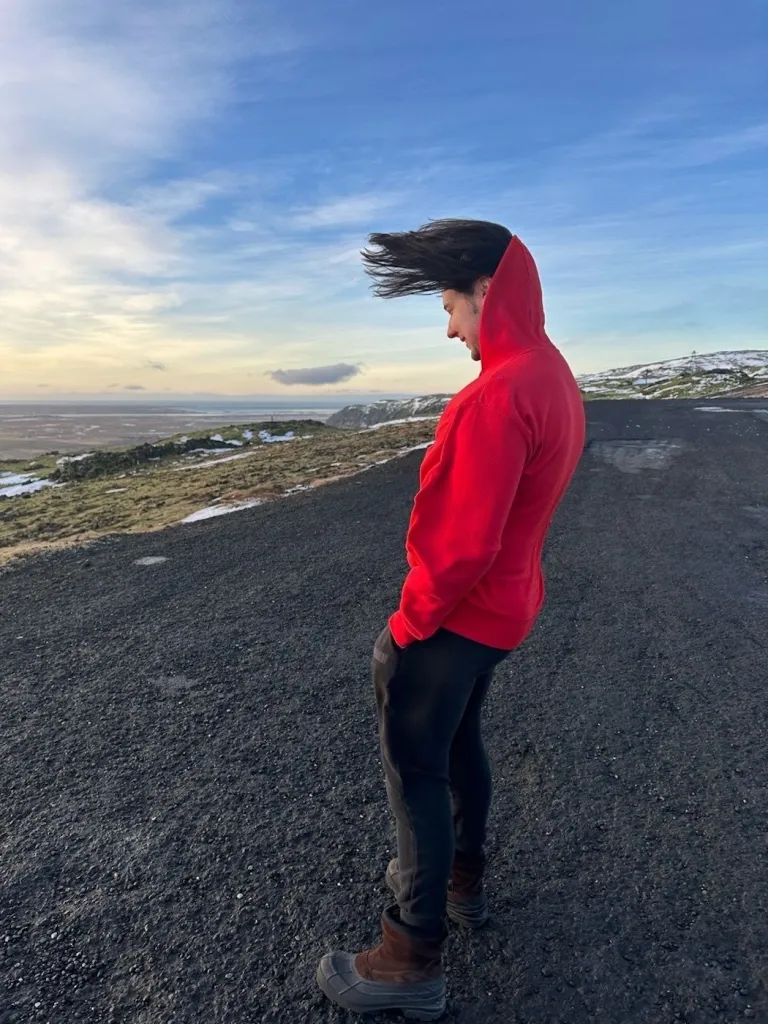
Icelandic forecasts give wind in metres per second, and wind is what shapes a day outdoors here. Rain rarely falls straight down. It arrives sideways, finds the gap between collar and hat, and soaks the one part of you that was not covered.
Which is why a thick coat that lets wind through will leave you cold, and a thin shell that blocks both wind and water will not.
Wind chill applies in summer too. A bright 12 °C day on an exposed coast reads far colder.
Once clothing is wet, warmth stops working. Dry matters more than thick.
Waterproof and windproof are two separate claims on a label. You want both.
Checking the forecast before you get dressed
The gentlest habit you can bring to Iceland takes two minutes over breakfast. Open vedur.is, look at the wind figure, and dress for that rather than for the plan you made three weeks ago.
The Icelandic Met Office issues colour-coded warnings; a yellow warning signals hazardous conditions to plan around, not necessarily a day to abandon. — Guide to Iceland, July 2026
Two companions are worth knowing. Road conditions are colour-coded on road.is, and SafeTravel carries alerts and lets you register a travel plan before heading out of the city. None of this needs to feel like homework — it is a slow check with a coffee in hand. If you are still choosing dates, which season suits your trip is worth reading alongside this list.
And if wind and water are the constants across all of them, the answer is not a longer packing list. It is a system.
The all-season layering system: three layers that work every month
Three layers. That is the whole wardrobe, in July and in January alike. What sits closest to your skin, what holds warmth in the middle, and what keeps the weather out on the outside.
Layer | Material | How many for a week | What it does |
Base | Merino wool or synthetic thermal | 2 sets (top and bottom) | Moves moisture away, keeps warming when damp |
Mid | Fleece jacket or lightweight wool | 1 | Holds warmth, comes off easily indoors |
Outer shell | Waterproof and windproof | 1 jacket, 1 pair of pants | Blocks rain and wind, protects everything under it |
Base layer: thermal wool or synthetic, never cotton
Merino wool or a synthetic thermal top and bottom, worn under everything else. Two sets carry a week comfortably, three a fortnight. They pack down to almost nothing and double as something soft to sleep in.
Cotton is the one material to leave behind. It holds water against your skin and stops warming you the moment it is damp, which in Iceland is most afternoons. Thermal layers do the opposite, and that difference is felt within an hour of the first rain shower.
Mid layer: fleece jacket or Icelandic wool sweater
One fleece jacket or one lightweight wool sweater is enough. It goes over the base layer and comes off the moment you step inside, which happens more often than people expect: cafés, pools, museums and shops here are all warm. Easy to remove matters as much as warm.
There is a pleasant alternative to carrying a bulky sweater across an ocean. Buy a lopapeysa in Reykjavík instead. It earns its space in the bag on the way home rather than on the way out, and it is the rare souvenir you will actually wear.
Outer shell: waterproof jacket and windproof pants
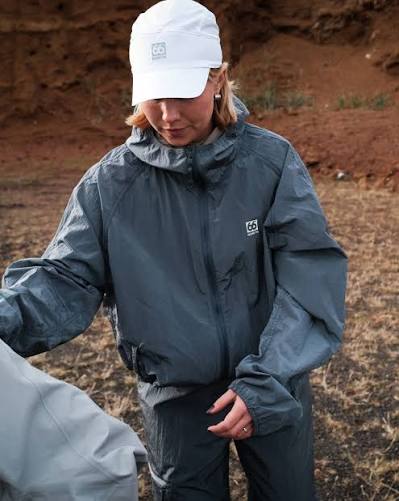
If one item has to be right, it is this one — and the detail that decides it is the pants. Far more people skip waterproof hiking pants than skip the jacket, and they regret it at the first waterfall.
The rest is in the small features, which are what separate a shell that works in 15 m/s from one that gives up.
A hood that fits over a hat, and stays up in wind
Taped seams, not simply a water-repellent finish
Adjustable cuffs and hem, so wind has nowhere to get in
Room underneath for the mid layer, without pulling tight across the shoulders
Hiking boots, woolen socks and what to wear on wet days
Waterproof hiking boots with real tread, worn in well before the flight. Blisters are a slow way to lose a day. Add one pair of comfortable shoes for the evening, and that is footwear settled.
Then woolen socks, several pairs. Wet feet end a day faster than cold hands ever will, and there is quiet satisfaction in changing into a dry pair back at the hotel.
Trainers are not enough here, and it has little to do with hiking. Waterfall spray, black-sand beaches and gravel car parks soak ordinary shoes within minutes. Even a day walking the city between day trips tends to end wetter than planned — which is a good argument for somewhere quiet to dry out and start again.
Those three layers stay with you all year. What changes is only what goes over and around them.
What changes with the season: winter gear and summer swaps
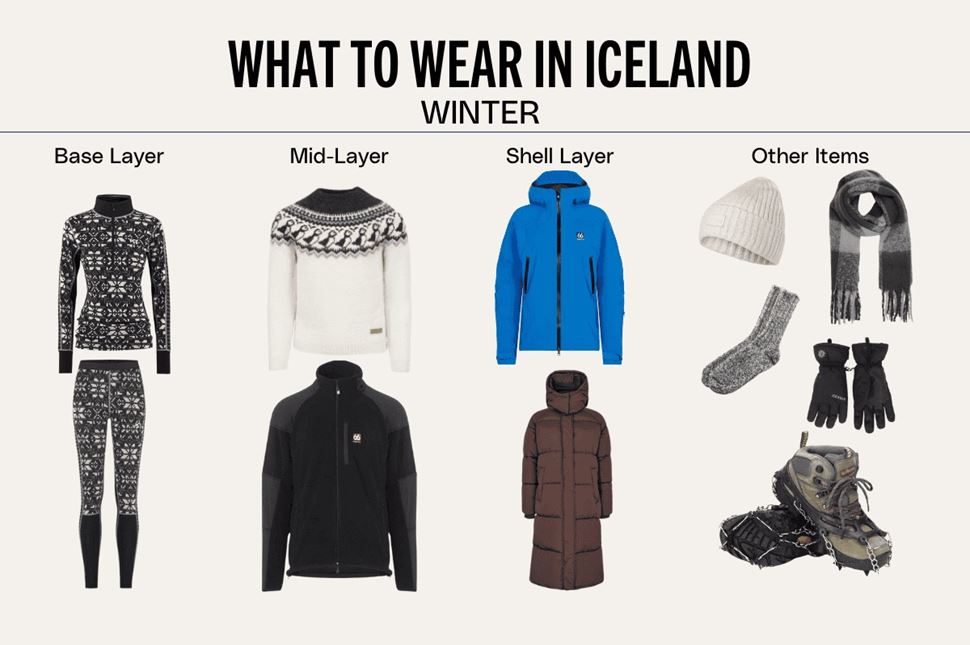
Here is the reassuring part. Moving from a July trip to a January one adds five or six items, not a second suitcase.
Item | Winter (October–April) | Summer (May–September) | Why |
Over the shell | Insulated jacket or parka | Not needed | Long stretches standing still outdoors |
|---|---|---|---|
Head and neck | Beanie, buff or balaclava | Thin beanie on windy coasts | Wind finds the head first |
Hands | Waterproof gloves, plus a spare pair | Light gloves | Wet gloves stop working |
Underfoot | Slip-on microspikes | Not needed | Pavements ice over before roads do |
Sleep | Nothing extra | Sleep mask | The light does not switch off |
Winter packing, October to April: beanie, balaclava, gloves, microspikes
That winter delta fits in the gaps of a bag you have already packed. One thing on the list is worth a sentence of its own: Reykjavík pavements ice over even when the roads look clear, and compact ice cleats are what people here actually use. Icelandic has a good word for them — mannbroddar, human spikes.
Sidewalks can be icy even when streets look clear, so compact ice cleats are very useful for city walking in Iceland. — Guide to Iceland, 16 June 2026
Aurora nights ask something particular of your packing. You are not walking; you are standing still in the dark for an hour, watching. Hand warmers and a second pair of gloves do more for that hour than another sweater would. Our guide to when and where to look for the aurora covers the timing side of it.
One small comfort for anyone driving: coming back at midnight with cold hands is easier when parking is free and a few steps from the door, rather than a circuit of a dark city looking for a space. If a loop of the island is on the plan, starting a road trip from a calm base is worth a look.
Summer packing, May to September: sleep mask, sun protection, lighter rain gear
Summer has one packing problem nobody warns you about, and it is not the cold. Around midsummer the sky over Reykjavík never truly darkens. A sleep mask is the item most travellers wish they had brought.
Sunglasses and sun cream, too. Low-angle light bounces off water, snow and black sand for most of the day, and a sunburn in a place this cool feels faintly absurd.
Otherwise, very little moves. The same shell, a lighter mid layer, and thermal base layers that stay in the bag rather than at home.
Crampons or microspikes? What tours provide and what you carry
Two different objects share one confusing name, and the difference decides whether you spend money before flying.
Glacier crampons are technical, sharp and made for walking on ice. On glacier hikes, ice climbs and ice-cave trips, the operator supplies them and hands them out before you step onto the ice. Nothing to buy, nothing to carry.
Slip-on microspikes are for everyday winter walking: icy pavements, car parks, the path beside a waterfall. These are the ones you bring or buy on arrival. Arctic Adventures lists them at ISK 3,500 a pair, in one size range covering EU 37–47, typically stocked October to April.
An honest verdict, then. Worth it if you are outside the city in winter. Optional if your trip is three unhurried days of Reykjavík cafés. And since the glacier and ice-cave tours booked at reception already include the technical gear, there is nothing extra to pack for them.
Clothing is settled. What remains is a short list of small things that quietly decide how a trip feels.
The small things worth packing, and the ones you can leave at home
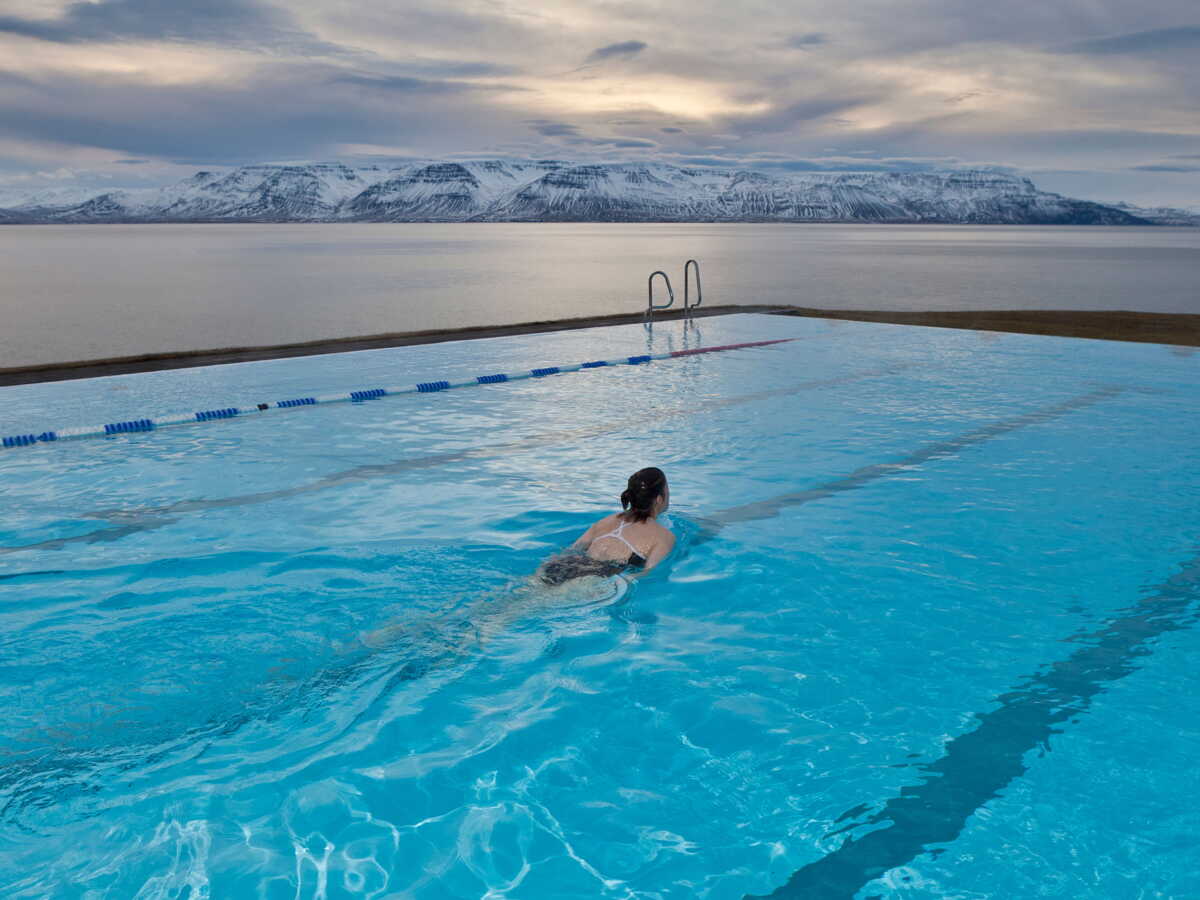
Swimsuit, quick-dry towel and the shower rule at every pool
The swimsuit is the item most often forgotten and most often needed, in every month of the year. Reykjavík has eighteen public geothermal pools, according to Visit Reykjavík, and Laugardalslaug — the largest of them — sits at the edge of the quiet green valley a short walk from us.
There is one custom worth knowing before you go, and it is a warm one rather than a rule to fear. Public pools use very little chlorine and rely on bathers keeping the water clean, which is why everyone showers with soap, without a swimsuit, before getting in (Guide to Iceland, 4 June 2026). The same applies at the built lagoons, where fitted cubicles offer more privacy.
Pay at the desk and take a locker key.
Shower with soap, without a swimsuit. Cubicles are available at most pools.
Put the swimsuit on, then walk out to the water.
Rinse afterwards, and let the warmth stay with you for the walk back.
A quick-dry towel saves a small rental fee at every pool you visit. If yours stays at home, most pools and lagoons rent both towels and swimsuits.
Power adapter, reusable bottle, day pack and camera gear
Iceland runs on 230 V at 50 Hz, with the European two-round-pin sockets of types C and F. Visitors from continental Europe need nothing. Visitors from the UK, North America and Japan need an adapter, and should check whether hair dryers and similar heat-based items are dual voltage before plugging them in.
Then a few quiet essentials:
A reusable bottle. Icelandic tap water is excellent and free, and refilling removes a daily errand and a daily cost.
A small day pack, for the layers you take off when the sun appears.
A power bank. Cold drains phone batteries faster than you expect on a long day out.
A lens cloth for your camera gear. Waterfall spray finds every lens in Iceland.
Packing lighter, because laundry and hot drinks are waiting in Reykjavík
Here is the part most packing lists never mention. A five-day wardrobe washed midway through a trip beats a twelve-day wardrobe carried across an ocean. Our laundry room is free and open to guests, which quietly changes the arithmetic of everything above. Bulky winter outerwear can also be rented in Reykjavík, with delivery to hotels, so a parka does not have to take up half a suitcase for a four-day trip.
Worth packing | Leave it at home |
Swimsuit and a quick-dry towel | An umbrella. Icelandic wind ends them within a day. |
Type C/F adapter and a power bank | Jeans as your main trousers. They soak and stay soaked. |
Reusable bottle and a small day pack | Cotton base layers. |
A dry pair of woolen socks in the day pack | Formal shoes, and bottled water. |
Arriving late is its own kind of packing problem: nobody wants to reorganise a suitcase at midnight. A virtual receptionist is available around the clock here, wet gear dries overnight, and the rooms are soundproofed, so a slow morning is still possible after a long one. If your flight lands after dark, the practicalities of arriving late on a stopover are worth a read.
Frequently asked questions
What should I pack for Iceland at this time of year?
The same three layers, whatever the month: a thermal base layer, a fleece or wool mid layer, and a waterproof, windproof shell with rain pants. Winter adds an insulated jacket, a beanie, gloves and microspikes. Summer swaps in a sleep mask and sunglasses. The core of your packing list does not change with the season.
What do I need to pack for 7 days in Iceland?
Two sets of thermal base layers, one fleece or wool sweater, one waterproof jacket, one pair of waterproof hiking pants, four or five pairs of woolen socks, worn-in hiking boots, one pair of evening shoes and a swimsuit. That fits a carry-on. Anything longer than a week is easier to wash midway than to carry.
What should you not bring to Iceland?
An umbrella is the classic mistake — the wind here ends them quickly. Cotton and denim are the others, since both hold water and stop keeping you warm. Formal shoes rarely come out of the bag on an Icelandic trip, and bottled water is needless: the tap water is excellent and free everywhere.
Do I need a swimsuit in Iceland?
Yes, in every season, and it is worth keeping near the top of the bag rather than at the bottom. Swimming outdoors in cold air is one of the gentlest things you can do here, and a pool visit is often decided on the day rather than planned. If yours stays at home, pools and lagoons rent both swimsuits and towels.
What power adapter do I need in Iceland?
A European type C or F plug adapter, for sockets running at 230 V and 50 Hz. Travellers from continental Europe need nothing at all. Phones, laptops and camera chargers are almost always dual voltage and need only the adapter; hair dryers and straighteners are the items to check, since single-voltage ones can fail here.
Do I need crampons or microspikes in Iceland?
Technical glacier crampons come with the tour, so there is nothing to buy or carry for a glacier hike or an ice cave. Slip-on microspikes, for icy pavements and waterfall paths, are the ones you bring yourself. Worth it if you are outside the city between October and April, optional for a few slow days in Reykjavík.
Packing for Iceland, and then not thinking about it again
The best outcome of a good packing list is that you stop noticing it. You dress from the window each morning, you come back damp and change into dry socks, and the weather stops being something to negotiate. It becomes, at most, a conversation over breakfast about which way the wind is going.
That is worth more than any single item in a suitcase, and it comes from packing less rather than more. A great deal of what people carry to Iceland travels here and back without ever leaving the bag.
So bring lighter than feels sensible. Wash something midway. Buy the wool sweater here rather than hauling one across an ocean.
When you're ready to slow down in Reykjavík, our quiet rooms in Laugardalur are here whenever you are — and there is no particular hurry about any of it.